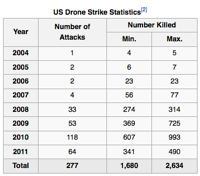
You are aware of the "Drone War" going on in Pakistan and other middle east countries, aren't you? Just in case you don't know, this CIA-led war has been going on since 2004, and involves sending robotic unmanned air vehicles to rain death and destruction upon people. Glenn Greenwald just posted a touching article about undesirable side effects of the Drone War. He informed us U.S. rules of engagement in Drone usage means we often do not know for certainty the victims of Drone attacks are actually combatants, and that this understandably results in increasing hatred towards the U.S. To me the Drone War just makes me think of the Robotic armies shown in Star Wars and also the relative bravery of sending actual people into direct combat, versus sending machines into combat instead.
The drone war isn't happening just in Pakistan, it's touching Yemen and other countries.
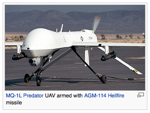
Drone attacks have increased substantially since President Obama took office. Generally the UAVs used are MQ-1 Predator and more recently MQ-9 Reaper firing AGM-114 Hellfire missiles.
There is much disagreement over the effects of these drone strikes. Some say the attacks are only killing al-Qaeda and Taliban, and there are zero non-combatant civilian casualties. Others say there are a few non-combatant casualties. And others say there is as much as 80% non-combatant casualties.
The phrase "non-combatant casualty" is nicey-nicey speech for people we might describe as "innocent bystanders". People who happen to be near a strike, and are accidentally killed in an attack. But what if our government is sending drones against targets they do not explicitly know are actual combatants? What if some times drone attack targeting is completely incorrect?
Since 2008 the CIA has relied less on a list of individual people ("high value targets") and has increasingly targeted patterns of suspicious behavior. This change in tactics resulted in fewer deaths of high-value targets and in more deaths of lower-level fighters, or even innocent bystanders. A Washington Post article reported that of 581 militants killed in the 118 strikes in 2010, only two were high value targets. Each strike costs $1 million to launch.
There are theoretical argument you make against these drone strikes. For example, that it violates the sovereignty of Pakistan, a country that has never attacked the U.S. and is supposedly an ally. Or that because CIA's drone operators are civilians directly engaged in armed conflict, this makes them "unlawful combatants" and possibly subject to prosecution.
Glenn Greenwald's piece refers to those theoretical arguments, but refers as well to another more personal side to this. A recent meeting was convened between Pashtun tribal elders from the Pakistan-Afghan border, and some westerners, so the tribal elders could present their side of the story. The meeting got written up as a NY Times op-ed by one participant, and as a blog post by another. One of the attendees was an 18 year old son of one of the combatants, by both reports a very nice young man who had bright visions for his future. But this young son was killed 72 hours later in a Drone strike because they were driving to "pick up their Aunt and bring her home to Norak".
That's a very innocent and very understandable task for a young man to undertake, drive their Aunt from one town to another. But if the CIA is targeting "suspicious activity" then perhaps they think a car driving at night is suspicious? Who defines what is suspicious?
Glenn Greenwald goes through a litany of evidence that, in general, "we" have no idea who's being killed in the drone attacks. More bothersome, the CIA themselves have no idea who's being killed. You would think that the CIA, the ones targeting the drone attacks, should know who they're attacking and have procedures to ensure they're attacking actual combatants. Instead, according to a Wall Street Journal article Greenwald links to, says the BULK of the attacks “target groups of men believed to be militants associated with terrorist groups, but whose identities aren’t always known.” Further he references a Spencer Ackerman article saying “The CIA is now killing people without knowing who they are, on suspicion of association with terrorist groups”.
Apparently the general consensus opinion held by We The People is to trust that the Government is "killing Terrorists" with these strikes, and presumably that proper procedures are being followed. But the truth is different. The truth is that often innocent bystanders are being killed.
The deaths of innocent bystanders justifiably angers the families and friends of those who were killed. That understandably could be part of the wave of fighting against American military presence in that area. They, even the ones who are not Taliban or al Qaeda sympathizers, understandably would see our troops as the enemy and as a result act to drive out Americans from their lands.
These deaths of innocent bystanders are being perpetrated by our government and have as an unintended consequence increased anger towards America.
Late last night it was announced Osama bin Laden had been killed in Pakistan, and a first thoughts was this wouldn't make any difference. (Osama bin Laden has been killed but will it make any long term difference?) Basically the argument is the radicalization of a generation of people all over the world due to the warring over Terrorism. In yesterdays blog post I wrote about the generation of Middle East people who've seen invasion and/or occupation of several countries by Western forces, widespread death and destruction, and this has acted to radicalize those people. But it occurs to me, the radicalization also extends to Americans due to the 10 years (or more) of demonization of the Terrorists.
Listening to voices on NPR reports this morning I hear grudge-holding and an inability to move on with ones life. For example they interviewed a fellow whose fiancee had been killed in the World Trade Center collapse, and he's turned his car into a rolling billboard with pictures of his fiancee with messages to "Never Forget". As sad as his story is, as understandable it is he's done this, it's a pattern that simply re-opens the wounds over and over and doesn't proceed to healing. The kind of healing which allows you to move on with your life rather than hanging on to the wound keeping it festering inside. I don't want to go too far down this line of thinking, and some events like the Sept 11 2001 attack are just so big that it's hard to imagine having real forgiveness towards the perpetrators. Spiritual traditions over millennia such as Christianity have taught forgiveness as a key central method for achieving peace.
This was a statement by Secretary of State Hillary Clinton in which she made it clear the efforts to stomp out the "Syndicate of Terror" would not stop. In one breath she expressed a hope that al Qaida's victims would find comfort that Justice had been Done, and then in the next breath she's saying the hunt will never stop. On the one hand Authority's role is to mete out mete out Justice in the form of prison sentences or executions. Right? On the other hand the "hunt will not stop" is a way to keep re-awakening the wounds these traumatic events have placed in our mutual psyche.
Islamists vow bin Laden death will not mute Jihad call: Contains quotes from several Islamic Jihadi message boards like "Osama may be killed but his message of Jihad will never die. Brothers and sisters, wait and see, his death will be a blessing in disguise." This is the voice of a radicalized person.
Taliban commander vows to avenge Bin Laden's death: Quotes several "commanders" in several Terrorist organizations saying this "will bring no change to jihad." It's a martyrdom situation and his value as a marketing image will not be diminished by death. Right? The article describes Osama bin Laden as "the Shiekh" as someone who inspired people all over the Middle East into fighting a "holy war (a.k.a. Jihad) against the infidels and their agents." The movement is described as having separated "ideology from leadership" in that local al Qaida "affiliate" organizations have sprung up without direct oversight by the al Qaida leadership.
That same article has an interesting paragraph indicating a hatred towards al Qaida by regular folk in the Middle East.
For many years, the Sheikh had been isolated, his organisation disrupted not only by US kill teams and lethal drone attacks but also by general Muslim apathy and outright hostility to the organisation. For most of the victims are Muslim: not only Shia Muslims and Sunni moderates and seculars, but also bystanders who have committed the deadly sin of buying vegetables while one of those holy warriors decides to fight his battle and start his ascendance to the hereafter.
Osama bin Laden's death resonates in Rochester area: Has a range of reactions in the Rochester NY area. From "The only thing I can say is: it’s about time. I would’ve liked if we could’ve taken him alive and put him on trial. Then, a lot more people would understand the role that he played on 9/11." To "It’s probably not going to last very long, but that’s what they’re fearing right now: repercussions." To "It's about time and I'm glad we got him. Getting these guys is good. We are doing something and we are getting them." To "I don't think killing anyone is a good thing. People like bin Laden certainly need to be taken out of circulation, but I don't think killing is the best way to do it. I'm glad he will not bother anyone anymore, but there are probably plenty more like him." To "I felt a sense of relief. It’s been a long time since that day. It’s not going to bring Rich back." To "It’s a mixed feeling because you don’t want to celebrate someone being murdered, but it does give us a sense of security." To "I’m thrilled he’s captured and killed. It’s sad to me that we’re solving this awful crime with a killing." To "It’s great news. It’s been a long time. I feel like that means the war is finally over." To "It's outstanding, but I don't think it changes much for us in Afghanistan. "We still have the Taliban to contend with and we obviously have to finish what we started."
Beyond bin Laden: Is a post on the "Shadow Government" blog at ForeignPolicy.com which describes itself as being "written by experienced policy makers from the loyal opposition" so we should take this with a grain of salt in that it might be skewed towards ObamaSlander. In any case it's an interesting article. They start with saying the person who "emerges as the leader of al Qaeda will be enormously consequential for the movement's direction and appeal throughout the Muslim world." A supposedly likely successor, Ayman al Zawahiri, "has repeatedly emphasized Egypt as the centerpiece of al Qaeda's quest to re-establish a caliphate in the heart of the Islamic world." And: "Protracted wars are not decided on the outcome of any individual episode. Rather, they turn on the progressive attrition of the adversary's sources of power. Similarly, this conflict will not end in a single battle or campaign. Rather, al Qaeda and its extremist vision will be defeated through the patient accumulation of quiet successes. Victory will include discrediting extremist ideology, creating fissures between and among extremist groups, and reducing them to the level of a nuisance, groups that can be tracked and handled by local law enforcement groups."
A long nightmare is over? The leader of al Qaeda, Osama bin Laden, has been killed in northwest Pakistan. I suppose it's not a surprise he was there, except that he wasn't in the mountains but in Abbottabad, in the far north next to the border with Kashmir. According to statements on BBC World Service right now, he was living in a Mansion in a medium sized city, just a few hundred yards from the police station, and one assumes it wasn't exactly a secret he was there and there must have been some cooperation with the Pakistani government that he could be living there. But my question is whether this will make any real difference. UPDATE: For a followup see Reactions to bin Laden's death indicates this won't make much change or difference?
Nowadays what's going on is a whole generation of people growing up with the U.S. and Western forces having invaded the Middle East. Many have been radicalized by these invaders (that is, "us") and I think most of the fighting is an effort to evict occupiers rather than people in ideological cahoots with al Qaeda.
In the prosecution of the U.S. led War on Terror many innocents were killed. Sometimes it was weapons going astray, killing innocent bystanders. Sometimes it was mistaken targets. Sometimes it was bogus intelligence. And there was this issue with the invasion of Iraq, resulting in the death of a hundred thousand or more Iraqi's, based on bogus illegal U.S. policies. Radicalization is quite understandable to a people who suffered the pain inflicted upon them by the U.S. led war.
As I write there are thousands of people gathered outside the White House celebrating, even though it's after midnight. And indeed it is wonderful to hear this news, that the supposed leader of al Qaeda, that supposedly is responsible for the murder of thousands of people, that Osama bin Laden has been killed.
But I question whether this will make any difference. Will the radicalized generation give up the hatred of the U.S. engendered in them by U.S. actions?
In President Obama's remarks (below) he said "Yet his death does not mark the end of our effort. There’s no doubt that al Qaeda will continue to pursue attacks against us. We must –- and we will -- remain vigilant at home and abroad." In other words, the War on Terror is not over. We can expect reprisal attacks and a continuing of the war.
Obama clearly wouldn't be willing to say the things I just said about a radicalized Middle East, but essentially we're saying the same thing, just through different lenses.
Remarks by the President on Osama Bin Laden
East Room
11:35 P.M. EDT
THE PRESIDENT: Good evening. Tonight, I can report to the American people and to the world that the United States has conducted an operation that killed Osama bin Laden, the leader of al Qaeda, and a terrorist who’s responsible for the murder of thousands of innocent men, women, and children.
It was nearly 10 years ago that a bright September day was darkened by the worst attack on the American people in our history. The images of 9/11 are seared into our national memory -- hijacked planes cutting through a cloudless September sky; the Twin Towers collapsing to the ground; black smoke billowing up from the Pentagon; the wreckage of Flight 93 in Shanksville, Pennsylvania, where the actions of heroic citizens saved even more heartbreak and destruction.
And yet we know that the worst images are those that were unseen to the world. The empty seat at the dinner table. Children who were forced to grow up without their mother or their father. Parents who would never know the feeling of their child’s embrace. Nearly 3,000 citizens taken from us, leaving a gaping hole in our hearts.
On September 11, 2001, in our time of grief, the American people came together. We offered our neighbors a hand, and we offered the wounded our blood. We reaffirmed our ties to each other, and our love of community and country. On that day, no matter where we came from, what God we prayed to, or what race or ethnicity we were, we were united as one American family.
We were also united in our resolve to protect our nation and to bring those who committed this vicious attack to justice. We quickly learned that the 9/11 attacks were carried out by al Qaeda -- an organization headed by Osama bin Laden, which had openly declared war on the United States and was committed to killing innocents in our country and around the globe. And so we went to war against al Qaeda to protect our citizens, our friends, and our allies.
Over the last 10 years, thanks to the tireless and heroic work of our military and our counterterrorism professionals, we’ve made great strides in that effort. We’ve disrupted terrorist attacks and strengthened our homeland defense. In Afghanistan, we removed the Taliban government, which had given bin Laden and al Qaeda safe haven and support. And around the globe, we worked with our friends and allies to capture or kill scores of al Qaeda terrorists, including several who were a part of the 9/11 plot.
Yet Osama bin Laden avoided capture and escaped across the Afghan border into Pakistan. Meanwhile, al Qaeda continued to operate from along that border and operate through its affiliates across the world.
And so shortly after taking office, I directed Leon Panetta, the director of the CIA, to make the killing or capture of bin Laden the top priority of our war against al Qaeda, even as we continued our broader efforts to disrupt, dismantle, and defeat his network.
Then, last August, after years of painstaking work by our intelligence community, I was briefed on a possible lead to bin Laden. It was far from certain, and it took many months to run this thread to ground. I met repeatedly with my national security team as we developed more information about the possibility that we had located bin Laden hiding within a compound deep inside of Pakistan. And finally, last week, I determined that we had enough intelligence to take action, and authorized an operation to get Osama bin Laden and bring him to justice.
Today, at my direction, the United States launched a targeted operation against that compound in Abbottabad, Pakistan. A small team of Americans carried out the operation with extraordinary courage and capability. No Americans were harmed. They took care to avoid civilian casualties. After a firefight, they killed Osama bin Laden and took custody of his body.
For over two decades, bin Laden has been al Qaeda’s leader and symbol, and has continued to plot attacks against our country and our friends and allies. The death of bin Laden marks the most significant achievement to date in our nation’s effort to defeat al Qaeda.
Yet his death does not mark the end of our effort. There’s no doubt that al Qaeda will continue to pursue attacks against us. We must –- and we will -- remain vigilant at home and abroad.
As we do, we must also reaffirm that the United States is not –- and never will be -– at war with Islam. I’ve made clear, just as President Bush did shortly after 9/11, that our war is not against Islam. Bin Laden was not a Muslim leader; he was a mass murderer of Muslims. Indeed, al Qaeda has slaughtered scores of Muslims in many countries, including our own. So his demise should be welcomed by all who believe in peace and human dignity.
Over the years, I’ve repeatedly made clear that we would take action within Pakistan if we knew where bin Laden was. That is what we’ve done. But it’s important to note that our counterterrorism cooperation with Pakistan helped lead us to bin Laden and the compound where he was hiding. Indeed, bin Laden had declared war against Pakistan as well, and ordered attacks against the Pakistani people.
Tonight, I called President Zardari, and my team has also spoken with their Pakistani counterparts. They agree that this is a good and historic day for both of our nations. And going forward, it is essential that Pakistan continue to join us in the fight against al Qaeda and its affiliates.
The American people did not choose this fight. It came to our shores, and started with the senseless slaughter of our citizens. After nearly 10 years of service, struggle, and sacrifice, we know well the costs of war. These efforts weigh on me every time I, as Commander-in-Chief, have to sign a letter to a family that has lost a loved one, or look into the eyes of a service member who’s been gravely wounded.
So Americans understand the costs of war. Yet as a country, we will never tolerate our security being threatened, nor stand idly by when our people have been killed. We will be relentless in defense of our citizens and our friends and allies. We will be true to the values that make us who we are. And on nights like this one, we can say to those families who have lost loved ones to al Qaeda’s terror: Justice has been done.
Tonight, we give thanks to the countless intelligence and counterterrorism professionals who’ve worked tirelessly to achieve this outcome. The American people do not see their work, nor know their names. But tonight, they feel the satisfaction of their work and the result of their pursuit of justice.
We give thanks for the men who carried out this operation, for they exemplify the professionalism, patriotism, and unparalleled courage of those who serve our country. And they are part of a generation that has borne the heaviest share of the burden since that September day.
Finally, let me say to the families who lost loved ones on 9/11 that we have never forgotten your loss, nor wavered in our commitment to see that we do whatever it takes to prevent another attack on our shores.
And tonight, let us think back to the sense of unity that prevailed on 9/11. I know that it has, at times, frayed. Yet today’s achievement is a testament to the greatness of our country and the determination of the American people.
The cause of securing our country is not complete. But tonight, we are once again reminded that America can do whatever we set our mind to. That is the story of our history, whether it’s the pursuit of prosperity for our people, or the struggle for equality for all our citizens; our commitment to stand up for our values abroad, and our sacrifices to make the world a safer place.
Let us remember that we can do these things not just because of wealth or power, but because of who we are: one nation, under God, indivisible, with liberty and justice for all.
Thank you. May God bless you. And may God bless the United States of America.
Ray McGovern has an article on alternet.org whose starting point is very interesting. The typical press briefing has journalists taking dictation from the press secretary, and the journalists simply report what was said. Very little analysis is being done by journalists today. Hence the Bush and now the Obama administrations have had a free hand to tell us what they want us to hear about the purpose and reason for this war on terror. Even though the Bush administration was clearly lying through its teeth the whole time, the journalists did not scratch very deep into the stories to learn the truth.
Journalists, McGovern says, are afraid of being labeled as non-patriotic or "with the enemy". That tactic, labeling critics as enemies of the state, was harshly used during the Bush43 years to stifle criticism.
At a White House Press Conference covering the underwear bomber (Abdulmutallab) of Dec 25, 2009, the press secretary and journalists were all going through the dictation exercise when Helen Thomas asked "Why?".
Thomas: "And what is the motivation? We never hear what you find out on why."
Brennan: "Al Qaeda is an organization that is dedicated to murder and wanton slaughter of innocents… They attract individuals like Mr. Abdulmutallab and use them for these types of attacks. He was motivated by a sense of religious sort of drive. Unfortunately, al Qaeda has perverted Islam, and has corrupted the concept of Islam, so that he’s (sic) able to attract these individuals. But al Qaeda has the agenda of destruction and death."
Thomas: "And you’re saying it’s because of religion?"
Brennan: "I’m saying it’s because of an al Qaeda organization that used the banner of religion in a very perverse and corrupt way."
Thomas: "Why?"
Brennan: "I think this is a — long issue, but al Qaeda is just determined to carry out attacks here against the homeland."
Thomas: "But you haven’t explained why."
That was McGovern's starting point on an very interesting exploration into the real "why" that the terrorists are doing what they're doing. By the way, this Ray McGovern is the former CIA analyst shown in Uncovered: The Whole Truth about the Iraq War giving great analysis into the truth behind the fictions of the Iraq War. Ray McGovern was a top CIA analyst who had been the intelligence briefer for Ronald Reagan and other top officials during the Reagan and Bush41 era. This sure gives a lot of credibility to what he has to say.
What we have here is a failure to communicate: The first issue McGovern raises is the Obama administration plan to increase efforts in communicating with the terrorists. By communicating clearly to Muslims Obama hopes to explain that the al Qaeda agenda is a perversion of Islam and that the U.S. stands with those who seek justice and progress. McGovern asks
Does a smart fellow like Obama expect us to believe that all we need to do is "communicate clearly to Muslims" that it is al Qaeda, not the U.S. and its allies, that brings "misery and death"? Does any informed person not know that the unprovoked U.S.-led invasion of Iraq killed hundreds of thousands of Iraqis and displaced 4.5 million from their homes? How is that for "misery and death"?
and
But why isn't there a frank discussion by America’s leaders and media about the real motivation of Muslim anger toward the United States? Why was Helen Thomas the only journalist to raise the touchy but central question of motive?
The reason given by Khalid Sheikh Mohammed as to why he masterminded the attacks on 9/11: Both the Bush43 and Obama administration have repeatedly given the same explanation of "why". Namely that the terrorists "hate our freedom" and that's why they're willing to continue this insane rampage of death and destruction. Being driven by perverted religious ideas their thought is to stamp out freedom? Um?
Instead McGovern quotes this apparently controversial bit from the 9/11 Commission report:
"America’s policy choices have consequences. Right or wrong, it is simply a fact that American policy regarding the Israeli-Palestinian conflict and American actions in Iraq are dominant staples of popular commentary across the Arab and Muslim world." (p. 376)
And this further bit the report has to say about KSM
"By his own account, KSM’s animus toward the United States stemmed … from his violent disagreement with U.S. foreign policy favoring Israel."
This wasn't about hating our freedom. It was about hating U.S. foreign policy. Especially our policy in the Middle East, in Israel, in Palestine, in Lebanon, etc. Occupation of Saudi Arabia, of Kuwait, etc. The killing of hundreds of thousands of civilians in Iraq. Or as McGovern put it:
After all, people in the Middle East already know how Palestinians have been mistreated for decades; how Washington has propped up Arab dictatorships; how Muslims have been locked away at Guantanamo without charges; how the U.S. military has killed civilians in Iraq, Afghanistan and elsewhere; how U.S. mercenaries have escaped punishment for slaughtering innocents.
The pain and suffering inflicted on the Middle East by western forces (primarily the U.S.) is the main issue here. U.S. policy in the middle east is rather unjust. The word "Blowback" was invented after the 1952 U.S. intervention in Iran which put the Shah in power, which saw him toppled in 1978, which saw the U.S. embassy overtaken by Iranian radicals during 1979, and which has left Iran as a supposedly dangerous threat in the Middle East. McGovern doesn't say anything about Iran in his article, but this story is part of the background reasons for todays war on terror. As explained in earlier postings the Project for a New American Century (a neocon thinktank which included dozens of people who went on to positions of power during the Bush43 years) planned to completely reshape the Middle East by first toppling Iraq's government and then toppling either/both Syria and/or Iran (see Is Syria (or Iran) next? and Background material for the second Gulf "War").
Israel: In the U.S. criticising American support for Israel is routinely squelched. He explains one incident, a former CIA analyst and specialist on al Qaeda, Michael Scheuer, has been "outspoken on what he sees as Israel’s tying down the American Gulliver in the Middle East". Scheuer was recently on C-SPAN complaining "bitterly that any debate on the issue of American support for Israel and its effects is normally squelched" and then went on to explain how the Israel Lobby got him "him removed from his job at the Jamestown Foundation think tank for saying that Obama was 'doing what I call the Tel Aviv Two Step.'"
More to the point, Scheuer asserted: "For anyone to say that our support for Israel doesn’t hurt us in the Muslim world … is to just defy reality."
McGovern referred to a Salon.COM post by Glenn Greenwald discussing a little noticed Associated Press report about the underwear bomber, Abdulmutallab. Rather than hating our freedom his Yemeni friends noted "that he was open about his sympathies toward the Palestinians and his anger over Israel’s actions in Gaza". Abdulmutallab was not someone with prior "terrorist" affiliations but someone who's anger over the Israel/Palestine conflict was used to manipulate him into committing violence. The merger announcements of Saudi and Yemeni branches of al Qaeda into al Qaeda of the Arabian Peninsula "railed against the Israeli attack on Gaza".
And on Dec. 30, Humam Khalil Abu Mulal al-Balawi, a 32-year-old Jordanian physician from a family of Palestinian origin, killed seven American CIA operatives and one Jordanian intelligence officer near Khost, Afghanistan, when he detonated a suicide bomb.
All these are not about "hating American freedoms" but are blowback by "terrorist" forces against U.S. support of Israel.
Violence piled upon Violence only begets more Violence: This is a phrase which has been with me since September 11, 2001. McGovern has this to say:
Is the reported reaction of a CIA official to al-Balawi’s attack the appropriate one: "Last week’s attack will be avenged. Some very bad people will eventually have a very bad day."
In other words the CIA response to the al-Balawi suicide bombing is Revenge. We've seen above that the U.S. toppling of the Iran government to install the Shah led to a lot of "blowback" which is a strange reframing word for "revenge". McGovern also goes into the events surrounding the brutal killing of Blackwater contractors in March 2004.
They'd taken a wrong turn and ended up in Fallujah, then attacked, murdered, and a grisly scene ensued with their bodies being drug through the street and so on. Later that year, the week after Bush43 won the 2004 election, an attack was launched on Fallujah. Revenge. That act of Revenge by the U.S. led to a drastic uptick in violence in Iraq. Was the killing of Blackwater contractors simply the raving actions of insane radicals? I think this is what officialdom would have us believe.
McGovern says it was inspired by the "March 22, 2004, Israeli forces assassinated the then-spiritual leader of Hamas in Gaza, Sheikh Yassin — a withering old man, blind and confined to a wheelchair." The people leading the murder of the Blackwater contractors called themselves the "Sheikh Yassin Revenge Brigade" and pamphlets and brochures were all over the scene about Sheikh Yassin.
The U.S. revenge attack on Fallujah was caused by a revenge attack on Blackwater guards over the Israeli assassination of a Hamas leader in Gaza which was likely itself Israeli revenge over something or other. Violence piled upon Violence only begets more Violence.
What we have here is a failure to communicate: McGovern closes by describing U.S. officialdom as refusing to communicate clearly with the American people about these issues. As said above he describes the press as simply taking dictation and repeating the words officialdom wants them to say. It means that officialdom is not telling the public the whole story. It means the American people are in the dark about what's really going on.
In a way this explains why there are so many deluded people in the U.S. The journalists whose proper role is investigation and exposing of lies, they're miserably failing at that job. This leaves the American people supporting stupid policies because they're woefully underinformed and misled by official lies.
In the news right now are many articles talking about a "UN Mandate" that will expire at the end of 2008, beyond which U.S. presence would not be allowed. UN Mandate? What Mandate? In Feb 2003 the United Nations voted against approving the invasion of Iraq, and (former) Secretary General Kofi Annan said the U.S. war in Iraq was illegal.
State: UN mandate in Iraq not needed relates an assertion by the U.S. State Department saying that neither a UN mandate nor Congressional approval is required to continue U.S. presence in Iraq. It further explains that with the expiration of the UN mandate the administration is negotiating a different agreement, a "long-term security plan", and that this agreement also would not require Congressional approval because it's not a "treaty". Elsewhere the article refers to Democrats who say all this is unconstitutional. Uh, yeah, unconstitutional activities would legitimately result in impeachment and conviction, would it not? Then why aren't the Democrats taking the impeachment resolutions seriously?
In any case the article does say this about the mandate: In his statement, Satterfield cites two legislative measures that he says gives the administration cover to remain in Iraq: the 2001 and 2002 resolutions authorizing force in Iraq and against nations harboring al-Qaida terrorists.
These are: United Nations Security Council Resolution 1382 (29 November 2001) which appears to be a continuing resolution granting continued approval for disarmament activities and names UNMOVIC and a specific list of armaments etc supposedly present in Iraq. And United Nations Security Council Resolution 1441 which deplores the uncooperativeness expressed by Iraq etc and threatens further actions etc and again names UNMOVIC. In reviewing the UN Security Council Resolutions there's a large number of them which concern the situation in Iraq and often are worded to continue approval for prior resolutions. It's likely the mandate in question is derived from one of these continuing resolutions and it's possible the U.S. Administration believes it has authority deriving from the authority granted to UNMOVIC and previous organizations, whose intent was to disarm Iraq following the 1992 Gulf War.
There were similar prior events surrounding prior extensions of a UN Mandate. In late 2007 The Extension of the United Nations Mandate for Iraq discusses a mandate that would expire at the end of 2007 and discusses a previous mandate that would have expired in 2006. In 2007 Iraqi Prime Minister Nouri al-Maliki sent a letter to the UN Security Council requesting that the Council extend the mandate of the U.S.-led Multinational Forces for one year, beginning December 31, 2007. However for al-Maliki to do this was unconstitutional by the Iraqi Constitution, as it requires The Council of Representatives (their Parliament) to be involved with such requests. And, also in 2007, the Council of Representatives, sent to the UN a letter requesting that the mandate not be extended. "The Iraqi Cabinet has unilaterally requested a renewal of the U.N. mandate keeping the occupation troops (MNF) in Iraq" despite the fact that "such a request issued by the Iraqi cabinet without the Iraqi parliament's approval is unconstitutional."...The important thing to understand is that the run-around goes beyond the issue of the mandate itself. Iraq is not in the midst of an incomprehensible religious war over some obscure theological differences between Sunni and Shiite Muslims but is deeply and profoundly divided over fundamental questions about the future of the country. In cutting the nationalist majority in the parliament out of the process of governing, the Maliki administration, Bush administration and, apparently, the U.N. secretary-general are making political reconciliation much more difficult.
Bush, Maliki Break Iraqi Law to Renew U.N. Mandate for Occupation By Raed Jarrar and Joshua Holland, AlterNet. Posted December 20, 2007 also covers the questionable legal status of the 2007 mandate extension. ...The move violated both the Iraqi constitution and a law passed earlier this year by the Iraqi parliament...Earlier in the week, a group representing a majority of lawmakers in Iraq's parliament sent a letter to the Security Council, a rough translation of which reads: "We reject in the strongest possible terms the unconditional renewal of the mandate and ask for clear mechanisms to obligate all foreign troops to completely withdrawal from Iraq according to an announced timetable."...This move speaks to the degree to which occupation and democracy are mutually exclusive, and to how Bush and Maliki must run roughshod over the Iraqi legislature (not to mention the U.S. Congress), sacrificing opportunities for political reconciliation along the way, in order to maintain an almost universally despised American military presence in the country....The U.N. mandate provides vital political cover for the occupation. The Bush administration has ignored or violated much of the international law governing the conduct of an occupying power. As Orwellian as it is, the United States, having bombed the hell out of Iraq, invaded it with a huge mechanized army and installed a government that exists wholly within the confines of its sheltered "international zone" -- the "Green Zone" -- and now maintains that its troops are in the country by the invitation of that government. The United Nations' mandate is a key part of maintaining that fiction....
Hmm.. this process of renewing a supposed UN Mandate of the US Occupation of Iraq.. the US Administration asserts it doesn't need approval from the UN, from Congress, and that they've been flouting Iraqi law in forcing the Iraqi government to "request" extension of the Mandate ... Uh...?
Bush pledges on Iraq bases a ruse analyzes some recent Bush Administration statements about the negotiations concerning the coming mandate renewal slated to occur later this year. Basically a series of statements have been made which appear to be using obscurating legalese to make what are effectively permanent bases to be legally defined as not "permanent". There are allegations the Administration plans to use bases in Iraq as a launching pad for an invasion of Iran, which the Administration denies, but it's clear the Administration wishes to launch an invasion of Iran. At the same time the Administration is seeking justification for the presence of forces in Iraq. Bush's Word Games on Permanent Bases is essentially the same article, by the same author, discussing how the Administration is using word play to avoid admitting the truth.
Secret US plan for military future in Iraq outlines secret plans being negotiated between the U.S. and Iraq. It is a draft strategic framework agreement between the US and Iraqi governments, dated March 7 and marked "secret" and "sensitive", is intended to replace the existing UN mandate and authorizes the US to "conduct military operations in Iraq and to detain individuals when necessary for imperative reasons of security" without time limit. It goes on to relate how critics point out the agreement is including no limits, so while it may not be specifying "permanent" bases (as noted above about official word play), if there are no limits on U.S. presence and no limits on what U.S. forces can do, then it's effectively permanent, and effectively the bases could be used to launch an Iran war. ...Senator Edward Kennedy, a senior member of the armed services committee, have said it goes well beyond other such agreements and amounts to a treaty, which has to be ratified by the Senate under the constitution....
Q Mr. Secretary, there have been some critics who have questioned whether the talks with Iraq on a status of forces agreement could lead to security guarantees that might tie the hands of a future president in terms of how long to leave U.S. forces there. Is that a valid concern?
And the other thing is, they say that any agreement should go to Congress for congressional approval. What do you say to that?
SEC. GATES: Well, first of all, we haven't even -- we've hardly even started to talk about it among ourselves at this point. I think it's pretty clear that such an agreement would not talk about force levels. It would not involve -- we have no interest in permanent bases.
I think the way to think about the framework agreement is an approach to normalizing the relationship between the United States and Iraq.
As I say, I have -- there haven't even -- I haven't been involved in any discussions of what kind of form the agreement would make -- take or anything else. I do know that there's a strong commitment inside the administration to consult very closely with the Congress on this, but, you know, without any idea of what the form of an agreement is going to be right now, I think it's premature to talk about congressional agreement or executive agreement. I think we just don't know.
While the United States currently has status-of-forces agreements with 80 countries, including Japan, Germany and South Korea and a number of Iraq's neighbors, none of those countries are at war. And none has a population outraged about civilian deaths at the hands of armed American security contractors who are not answerable to the law of the land.
...The Bush administration has said the accords -- a status of forces agreement on the rights and responsibilities of U.S. troops in Iraq, and a vaguely defined "strategic framework" on the broader U.S.-Iraqi security and political relationship -- are "non-binding." But U.S. lawmakers have questioned whether they commit the United States to a long-term security role in Iraq and challenged the White House contention that that they do not require congressional approval. Both Republicans and Democrats have accused President Bush of trying to tie the hands of his successor.
In a letter Wednesday to Defense Secretary Robert M. Gates and Secretary of State Condoleezza Rice, the four senior members of the Senate Foreign Relations Committee emphasized that Congress is in charge of funding any administration commitment, "regardless of election outcomes in November."
The letter, signed by Chairman Joseph R. Biden Jr. (D-Del.) and ranking minority member Richard G. Lugar (R-Ind.), along with John F. Kerry (D-Mass.) and Chuck Hagel (R-Neb.), cited "the Constitutional and legal implications of these potentially sweeping arrangements," and said the need for legislative approval "remains an open issue."
...
... US and UK officials have argued that existing UN Security Council resolutions related to the first Gulf War and the subsequent ceasefire (660, 678), and to later inspections of Iraqi weapons programs (1441), had already authorized the invasion. Critics of the invasion have challenged both of these assertions, arguing that an additional Security Council resolution, which the US and UK failed to obtain, would have been necessary to specifically authorize the invasion....
No UN member has brought this issue of the war's legality before the Security Council and no nation-member of the International Criminal Court (ICC) has expressed the desire to have the ICC rule on the war's legality....The UN Security Council, as outlined in Article 39 of the UN Charter, has the ability to rule on the legality of the war, but has not been asked by any UN member nation to do so. ...
... UNSC resolution 1441 was passed unanimously on November 8, 2002 to give Iraq "a final opportunity to comply with its disarmament obligations" that had been set out in several previous resolutions (resolution 660, resolution 661, resolution 678, resolution 686, resolution 687, resolution 688, resolution 707, resolution 715, resolution 986, and resolution 1284). ...
...The legal right to determine how to enforce its own resolutions lies with the Security Council alone (UN Charter Articles 39-42), not with individual nations. On 8 November 2002, immediately after the adoption of Security Council resolution 1441, Russia, the People's Republic of China, and France issued a joint statement declaring that Council resolution 1441 did not authorize any "automaticity" in the use of force against Iraq, and that a further Council resolution was needed were force to be used. Critics have also pointed out that the statements of US officials leading up to the war indicated their belief that a new Security Council resolution was required to make an invasion legal, but the UN Security Council has not made such a determination, despite serious debate over this issue. To secure Syria's vote in favor of Council resolution 1441, Secretary of State Powell reportedly advised Syrian officials that "there is nothing in the resolution to allow it to be used as a pretext to launch a war on Iraq."...
...Debate about the legality of the 2003 invasion of Iraq under international law centers around ambiguous language in parts of UN Resolution 1441 (2002). The UN Charter prohibits any war unless it is out of self-defense or when it is sanctioned by the UN security council. If these requirements are not met international law describes it a war of aggression.
The position of the US and UK is that the invasion was authorized by a series of UN resolutions dating back to 1990. Resolution 1441 declared that Iraq was in "material breach" of the cease-fire under UN Resolution 687 (1991), which required cooperation with weapons inspectors. The Vienna Convention on the Law of Treaties states that under certain conditions, a party may invoke a "material breach" to suspend a multilateral treaty. Thus, the US and UK claim that they used their right to suspend the cease-fire in Resolution 687 and to continue hostilities against Iraq under the authority of UN Resolution 678 (1990), which originally authorized the use of force after Iraq invaded Kuwait. This is the same argument that was used for Operation Desert Fox in 1998.[29] They also contend that, while Resolution 1441 required the UNSC to assemble and assess reports from the weapons inspectors, it was not necessary for the UNSC to reach an agreement on the course of action. If, at that time, it was determined that Iraq breached Resolution 1441, the resolution did not "constrain any member state from acting to defend itself against the threat posed by Iraq"....
Revealed: Secret plan to keep Iraq under US control Bush wants 50 military bases, control of Iraqi airspace and legal immunity for all American soldiers and contractors (By Patrick Cockburn Thursday, 5 June 2008)
...the accord also threatens to provoke a political crisis in the US. President Bush wants to push it through by the end of next month so he can declare a military victory and claim his 2003 invasion has been vindicated...The timing of the agreement would also boost the Republican candidate, John McCain, who has claimed the United States is on the verge of victory in Iraq – a victory that he says Mr Obama would throw away by a premature military withdrawal....The US has repeatedly denied it wants permanent bases in Iraq but one Iraqi source said: "This is just a tactical subterfuge."...
...The reaction in Iraq to the US demands for the long-term use of military bases and other rights has been so furious that Washington is now offering limited concessions in the negotiations. For example, the US is lowering the number of bases it wants from 58 to "the low dozens" and says it is willing to compromise on legal immunity for foreign contractors...US ambassador to Iraq, Ryan Crocker, denied The Independent's report that the US wanted permanent bases in Iraq. But the reality of the US plan is that Iraqi authority would be purely nominal with a few Iraqi soldiers stationed outside the bases....It will also be difficult for the US to concede that the tens of thousands of foreign contractors in Iraq, who vary from heavily armed security men to support staff, be liable to Iraqi law because the US Army has become dependent on these forces and could scarcely function without them....
Media Matters, March 2, 2008, This week our guest is Alex Gibney, 2008 Academy Award winner for Best Documentary Feature for his film Taxi to the Dark Side. The interview makes this sound like a very important documentary about the U.S. move to the dark side. In 2001 V.P. Dick Cheney told us that in pursuing the war on Terror we, that is the U.S., would have to engage in dark activities and to work with nasty people. So here we are with a country that is now committing torture, a country who has an idealism that is being ignored by U.S. leaders like V.P. Cheney.
Quote:
In December 2002, an Afghan named Dilawar had scraped together enough money to buy a taxi. He was fingered by a paid informant as a terrorist connected with a rocket attack. Taken to the American prison at Bagram, Afghanistan, he was tortured so violently that he died after five days. An autopsy showed that his legs were so badly mauled, they would have had to be amputated, had he lived. Later, the informant who collected U.S. money for fingering him was proven to be the terrorist actually responsible for the crime the innocent Dilawar was charged with.
An official report said Dilawar died of "natural causes." The New York Times found an autopsy report describing the death as a homicide. After a belated investigation, a few U.S. soldiers were accused of the murder. No officers were involved. Dilawar was the first casualty after we started to "work the dark side." In all the torture scandals since, few officers have ever been charged. If all of these crimes took place without their knowledge, they would appear to be guilty of dereliction of duty, if nothing else.
In the Media Matters interview the director discusses several forms of cost related to the practice torture. The above is one cost, an innocent man who was fingered by another, and who died during "interrogation". This cost is the loss of life. However he also discussed another instance, one of the "high value detainees" who was transferred from FBI interrogation at Bagram Air Base through the CIA Extraordinary Rendition program to Egypt and officials who are more amenable to, ahem, cough, cough, enhanced interrogation techniques. The same sort of techniques which Pres Bush wants to allow (see: Bush veto limits on torture? Or did Bush say he supports use of torture?). That high value detainee was providing useful and actionable intelligence, but it was not the story which VP Cheney and Pres Bush wanted to hear, hence the transfer to the Egyptians. Under torture this high value detainee told the interrogators a pack of lies and those lies were later used to justify the invasion of Iraq.
That's the cost.. the blunderbuss of the wrong war at the wrong time against the wrong people which has visited upon the Iraqi's untold pain and suffering.
In the interview he discussed how, after World War II, the German military elite were prosecuted for war crimes under the doctrine of "command responsibility". Think about the Abu Ghraib scandal, supposedly perpetrated by some bad apples in the lowest ranks. However it was committed in the context of an administration who was investigating all the legal angles to justify the use of torture. They wrote many memo's discussing anti-torture laws as "quaint" and old-fashioned, and were they doing that just to hone their legal skills, or were they doing so to provide cover for a program of committing torture?
Quote:
KENNETH ROTH: The Bush administration very deliberately doesn’t promote human rights. It promotes this soft fuzzy concept of democracy. And the reason it does that is because it’s too embarrassing to talk about human rights when it’s been responsible for so many human rights abuses in the name of fighting terrorism. So it falls back on this feel-good concept.
Police in thought pursuit offers a good beginning point for considering the Violent Radicalization and Homegrown Terrorism Prevention Act of 20007 (Act). The bill hasn't passed, but "the bill passed the House of Representatives on Oct. 23 by a 404-6 vote under a rule suspension that curtailed debate. To borrow from House Speaker Nancy Pelosi, California Democrat, the First Amendment should not distract Congress from doing important business. The Senate companion bill (S. 1959)... has encountered little opposition" and the article describes it as "probably the greatest assault on free speech and association in the United States since the 1938 creation of the House Un-American Activities Committee (HUAC) .. Denuded of euphemisms and code words, the Act aims to identify and stigmatize persons and groups who hold thoughts the government decrees correlate with homegrown terrorism... The Act will inexorably culminate in a government listing of homegrown terrorists or terrorist organizations without due process; a complementary listing of books, videos, or ideas that ostensibly further "violent radicalization;" and a blacklisting of persons who have intersected with either list.". I suspect this web site would become enshrined in their records, right? The article was published, however, in the Washington Times, notoriously owned by the Rev. Moon and therefore a suspect news organ.
The status page (on Thomas.loc.gov) makes it clear this bill passed in the House of Representatives overwhelmingly, but under a suspension of the rules. I'll note three votes in particular. Kucinich voted against this, and both Conyers and Ron Paul did not vote.
It's current status is that it passed in the House of Representatives, overwhelmingly, and was referred to the Senate, where they've sent it to the Committee on Homeland Security and Governmental Affairs. The sponsor is Sen Collins, Susan M., and sole cosponsor is Sen Coleman, Norm.
The bill defines
Quote:
VIOLENT RADICALIZATION- The term `violent radicalization' means the process of adopting or promoting an extremist belief system for the purpose of facilitating ideologically based violence to advance political, religious, or social change
HOMEGROWN TERRORISM- The term `homegrown terrorism' means the use, planned use, or threatened use, of force or violence by a group or individual born, raised, or based and operating primarily within the United States or any possession of the United States to intimidate or coerce the United States government, the civilian population of the United States, or any segment thereof, in furtherance of political or social objectives
IDEOLOGICALLY BASED VIOLENCE- The term `ideologically based violence' means the use, planned use, or threatened use of force or violence by a group or individual to promote the group or individual's political, religious, or social beliefs
Those are interesting definitions. And I noted reading the House 'Debate' (links below) that some Representatives expressed 'shock' that not all 'terrorists' are foreigners. Um, what do you think about those who in the 1990's were murdering abortion doctors? They were publishing lists of abortion doctors, with home addresses, home telephone numbers, etc, and suggesting those people should be murdered in order to stop the murder of children through abortion. What do you think about the protests against 'Fags' or the attacks on Jewish synagogues or the Oklahoma City bombing? What do you think of the episodes over the last years where nooses were placed in ways that would remind the Negro Americans of the Lynchings in the past? And what would you think of ecology activists who torch Hummer dealerships and thereby get labeled as ecoterrorists?
These Congressmen, I suggest, are feigning shock or else have a very poor memory.
Terrorism is a military strategy. There isn't a set group of people who are terrorists. Terrorism is a strategy chosen all around the world by peoples who have no other means to express their rage and desire for change. I suspect that in the 1770's the British who were attacked by, for example, having tea shipments tossed into Boston Harbor, thought that those people were terrorists (the word 'Terrorist' hadn't been invented at the time, and they would have used some other word). The forefathers of the United States of America promoted the use of violence to achieve political change, yet they are extolled as leading lights and essentially freedom fighters.
One mans terrorist is another mans freedom fighter.
In the Findings they state
Quote:
The Internet has aided in facilitating violent radicalization, ideologically based violence, and the homegrown terrorism process in the United States by providing access to broad and constant streams of terrorist-related propaganda to United States citizens
Hmm, so I suppose that one consequence of this, if it were to become law, would be a clampdown on peoples freedom to publish on the Internet. However the Findings also state
Quote:
Any measure taken to prevent violent radicalization, homegrown terrorism, and ideologically based violence and homegrown terrorism in the United States should not violate the constitutional rights, civil rights, or civil liberties of United States citizens or lawful permanent residents
Pardon me if I don't receive much comfort from that statement. At least they are including in this proposed law guarantees of continued civil rights, but this reminds me of the saying that the cost of living in a Democracy is eternal vigilance against losing the Democracy.
The bill calls for the establishment within the legislative branch of the Government the National Commission on the Prevention of Violent Radicalization and Homegrown Terrorism. It would report on
Quote:
the facts and causes of violent radicalization, homegrown terrorism, and ideologically based violence in the United States, including United States connections to non-United States persons and networks, violent radicalization, homegrown terrorism, and ideologically based violence in prison, individual or `lone wolf' violent radicalization, homegrown terrorism, and ideologically based violence, and other faces of the phenomena of violent radicalization, homegrown terrorism, and ideologically based violence that the Commission considers important.
The bill calls for
Quote:
The Secretary of Homeland Security shall establish or designate a university-based Center of Excellence for the Study of Violent Radicalization and Homegrown Terrorism in the United States (hereinafter referred to as `Center') following the merit-review processes and procedures and other limitations that have been previously established for selecting and supporting University Programs Centers of Excellence.
With the purpose
Quote:
It shall be the purpose of the Center to study the social, criminal, political, psychological, and economic roots of violent radicalization and homegrown terrorism in the United States and methods that can be utilized by Federal, State, local, and tribal homeland security officials to mitigate violent radicalization and homegrown terrorism
The bill calls for
Quote:
International Effort- The Secretary shall, in cooperation with the Department of State, the Attorney General, and other Federal Government entities, as appropriate, conduct a survey of methodologies implemented by foreign nations to prevent violent radicalization and homegrown terrorism in their respective nations
Elsewhere in the bill they recognize that other countries, such as Ireland, the United Kingdom, and Israel, all have significant experience with homegrown terrorism, and that the U.S. can learn from them.
Finally, in SEC. 899F. PROTECTING CIVIL RIGHTS AND CIVIL LIBERTIES WHILE PREVENTING IDEOLOGICALLY BASED VIOLENCE AND HOMEGROWN TERRORISM the bill calls for auditing to prevent this bill from being abused to target specific racial groups, and that it not be used to degrade existing civil liberties.
In general the legislation does not specify any new crime definitions nor does it specify any new penalties. Instead it calls for the establishment of commissions to study the problem. I suppose though the fear is that these commissions will come up with some kind of expected information, that there are grave dangers to U.S. Society from something or other, and that therefore they will recommend the establishment of a thought police and actually outlaw us from thinking certain things. In other words the threat in this case is a potential future where the government has given itself the right to outlaw our thoughts and enforce somehow that we cannot think about certain things.
The Violent Radicalization and Homegrown Terrorism Prevention Act Offers an excellent tour through the history, in the United States, of fear-mongering legislation in the United States directed against groups and individuals believed to threaten the established order.
Democracy Now, November 20, 2007; Homegrown Terrorism Prevention Act Raises Fears of New Government Crackdown on Dissent is an interview by Amy Goodman (Democracy Now) with Jessica Lee and Kamau Karl Franklin discussing this bill. They raise alarm over the potential uses of this bill given the broad language used in the definitions. While Philip Giraldi (above) thinks the most likely target of this bill are the Muslims, the bill does contain broad definitions that could be applied to anybody. For example ecological protesters often attempt block activities like logging by chaining themselves to trees, or forming human chains that would block logging trucks and crews from entering the forest. These activities could be labeled as promoting violence.
Specifically interesting are these snippets connecting the bill with the Rand Corporation. Especially as the bills sponsor, Rep. Jane Harmon, has in her district the headquarters of the Rand Corporation.
Quote:
I found was a great influence by the Rand Corporation, which is a government affiliated think tank. Twice, Brian Michael Jenkins, who is an expert on terrorism, gave testimony in the House on this bill....the Rand Corporation’s other reports in 2005, they had a report called “Trends in Terrorism”. And they had one chapter called “Homegrown Terrorism Threats”. When you look in that chapter, there’s nothing about political Islamists. In fact, its all about anti- globalization people on the right and left side of the spectrum. The animal rights and the environmental movements; and anarchists....the Rand comment, particularly with Brian Michael Jenkins, supposed terrorist expert who’s mainly known according to Rand as someone who helped the United States in counter-insurgency measures in Vietnam, which is one of his claims to fame. In addition to that, he wrote a book and in his own book... that says “in their international campaign, the Jihadist will seek common ground with leftist, anti-American and anti-globalization forces who will in turn seek radical Islam comrades against a mutual foe.”
On October 23, 2007, the House of Representatives passed the Violent Radicalization and Homegrown Terrorism Prevention Act of 2007 by a vote of 404-6. The bill will be referred out of committee this week and will then go to the Senate floor. The National Lawyers Guild and the Society of American Law Teachers strongly oppose this legislation because it will likely lead to the criminalization of beliefs, dissent and protest, and invite more draconian surveillance of Internet communications.
In Congress' "anti-extremist" bill targets online thoughtcrime documents some instances of 'mission creep' related to this area. An actual example from the Alabama Department of Homeland Security states domestic terrorists are those Americans who say the "U.S. government is infringing on their individual rights, and/or that the government's policies are criminal and immoral." He goes on to suggest Al Gore would be labeled this way because he has made several speeches claiming the U.S. Government is following stupid illegal policies. Part of the Civil Liberties we have is the right to criticize the government. Fortunately the proposed law preserves existing civil liberties, but what if the commissions were to recommend that some civil liberties are threats against the government? Hurm.
Jessica Lee posted “Homegrown Terrorism” Bill Update outlining further information and activities related to this bill. It appears there is a growing movement to pressure the Senate committee to kill the bill.
On The Homegrown Terrorism Prevention Act: A Tutorial in Orwellian Newspeak goes through the bill looking for 'Orwellian' language. For example the bill starts with 'AN ACT - To prevent homegrown terrorism, and for other purposes', and that phrase 'other purposes' is more than suspicious.
Quote:
Future “other purposes” will undoubtedly be justified by the Act’s use of the term “violent radicalization,” which it defines as “the process of adopting or promoting an extremist belief system for the purpose of facilitating ideologically based violence . . .” or by the folksy, Lake Wobegonesque “homegrown terrorism,” defined as “the use, planned use, or threatened use, of force or violence by a group or individual born [or] raised . . . within the United States . . . to intimidate or coerce the United States, the civilian population . . . or any segment thereof . . . .”... A clue to future “other purposes” may lie in the Act’s parentage. The proud House “mother” of the Patriot Act’s evil twin is Rep. Jane Harmon (D-CA), chair of the Homeland Security Intelligence Subcommittee. Rep. Harmon has admitted to a long and productive relationship with the RAND Corporation, a California based think-tank with close ties to the military-industrial-intelligence complex. RAND’s 2005 study, “Trends in Terrorism,” contains a chapter titled, “Homegrown Terrorist Threats to the United States.” Is this Act a bastard child?... RAND maintains that “homegrown terrorism” will not be the result of jihadist sleeper cells. Rather, it will result from anti-globalists and radical environmentalists who “challenge the intrinsic qualities of capitalism, charging that in the insatiable quest for growth and profit, the philosophy is serving to destroy the world’s ecology, indigenous cultures, and individual welfare.”
I went through several pages of yahoogling and found basically universal warning "THIS IS HORRIBLE WE MUST STOP IT". However it appears many of those who are yelling DANGER didn't read the bill, or else are assuming this is just the first step to establish a crackdown on thought and freedom of speech and freedom of association. Perhaps it is. The bill clearly is worded very broadly and could be used in many ways.


 Ray McGovern has an article on alternet.org whose starting point is very interesting. The typical press briefing has journalists taking dictation from the press secretary, and the journalists simply report what was said. Very little analysis is being done by journalists today. Hence the Bush and now the Obama administrations have had a free hand to tell us what they want us to hear about the purpose and reason for this war on terror. Even though the Bush administration was clearly lying through its teeth the whole time, the journalists did not scratch very deep into the stories to learn the truth.

 McGovern referred to a Salon.COM post by Glenn Greenwald discussing a little noticed Associated Press report about the underwear bomber, Abdulmutallab. Rather than hating our freedom his Yemeni friends noted "that he was open about his sympathies toward the Palestinians and his anger over Israel’s actions in Gaza". Abdulmutallab was not someone with prior "terrorist" affiliations but someone who's anger over the Israel/Palestine conflict was used to manipulate him into committing violence. The merger announcements of Saudi and Yemeni branches of al Qaeda into al Qaeda of the Arabian Peninsula "railed against the Israeli attack on Gaza".


